

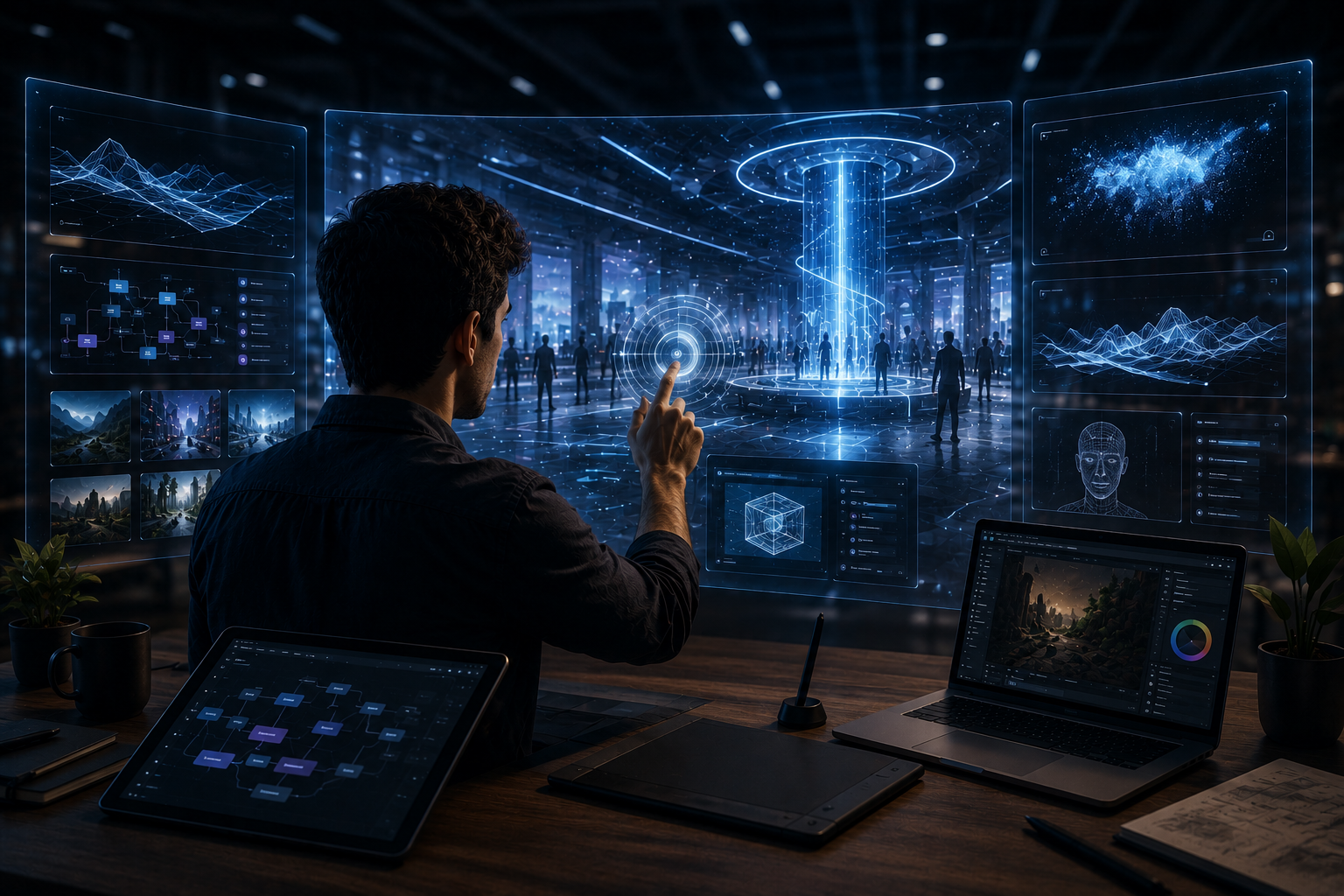
There is a lot of noise around AI and immersive technology right now.
Most of it focuses on the same things: AI-generated avatars, virtual assistants, algorithmically built worlds. Impressive demos. Futuristic headlines.
But if you are a company considering an immersive experience — for your visitors, your customers, your employees, or your brand — the more important question is not what AI can generate. It is what AI changes about how immersive experiences are built, deployed, and managed over time.
The answer to that question has significant implications for your investment, your timeline, and the long-term value you get from immersive technology.
Faster From Concept to Reality
Traditionally, bringing an immersive experience to life was a lengthy process. Environment design, 3D asset creation, interaction systems, content adaptation, multilingual support, testing — each stage required time, specialist resources, and multiple rounds of revision.
AI-assisted production workflows are compressing that timeline.
Today, teams can move from early concept to testable prototype significantly faster than before. Visual directions can be explored and validated earlier. Content variations can be generated and adapted more efficiently. Feedback loops that once took weeks can be tightened to days.
For companies, this matters in a practical way: you can see, test, and refine ideas before committing to full production. The cost of exploration goes down. The risk of investing in the wrong direction goes down with it.
Experiences That Evolve After Launch
One of the limitations of traditional immersive experiences is that they are largely fixed once deployed. A fixed narrative. A fixed language. A fixed set of interactions. Any update means going back into production.
AI introduces a different model.
Immersive environments can now be designed to adapt — to user behavior, language preferences, visitor profiles, time of day, crowd conditions, or operational context — in real time. For a public-facing installation, this means an experience that stays relevant and responsive rather than becoming outdated. For a training or enterprise environment, this means a system that can evolve alongside your organization without rebuilding from scratch every time.
The shift is from thinking of an immersive experience as a finished product to thinking of it as a living system.
Lower Barriers, Higher Ambition
AI is also changing what is achievable within a given budget and timeline.
Tasks that previously required large specialist teams and extended production schedules can now be executed more efficiently. This does not mean cutting corners — it means that more of your investment goes into creative and strategic quality rather than repetitive production tasks.
For companies, this opens up possibilities that may have felt out of reach before: more ambitious environments, richer content, faster deployment, and the ability to update and expand experiences over time without starting over.
The Operational Value Is Often Overlooked
Beyond the experience itself, AI is beginning to reshape how immersive systems are managed.
Analytics, behavior tracking, content management, predictive maintenance, real-time optimization — these operational layers are becoming increasingly sophisticated. For companies running large-scale or permanent immersive installations, this is often where the most tangible long-term value sits.
An immersive environment is not just a moment. It is a system that operates continuously, in real conditions, with real users. The ability to understand how it is performing, adapt it intelligently, and keep it running smoothly over time is what separates a strong investment from an expensive one-off.
What This Means If You Are Considering Immersive Technology
The most important thing AI changes for companies exploring immersive experiences is not the visual quality of what can be produced.
It is the relationship between ambition and feasibility.
More can be done, faster, with less risk, and with greater long-term adaptability than was possible even a few years ago. The companies that will get the most value from immersive technology are not necessarily the ones with the largest budgets. They are the ones working with teams that understand how to combine creative vision with intelligent production and operational thinking.
If you are exploring what immersive technology could do for your business, we would be glad to talk through what is possible.