

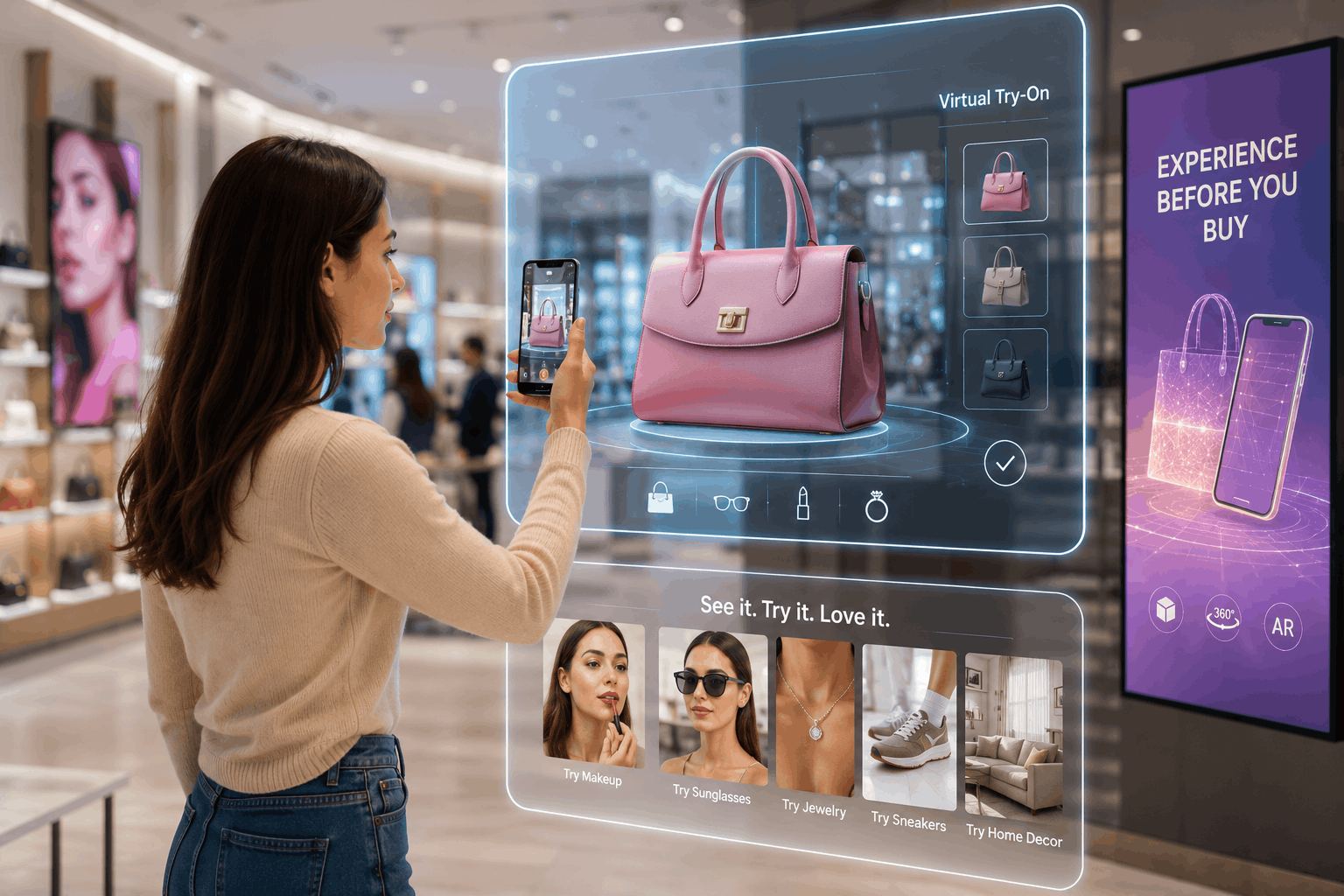
Retail Is Becoming More Visual
A few years ago, AR in retail was mostly associated with campaigns, activations, and social media filters. Today, it is becoming part of the customer journey itself.
Customers increasingly expect to visualize products before purchasing them. Whether it is trying on sunglasses through a smartphone camera, testing makeup shades virtually, or previewing furniture inside their own home, immersive retail experiences are becoming normal consumer behavior rather than experimental technology.
The shift is particularly noticeable in the UAE, where retail has always been strongly connected to experience.
Why AR Try-Ons Are Growing Fast
One of the biggest barriers in retail has always been hesitation. Customers want reassurance before making a purchase decision.
AR reduces that friction by allowing people to interact with products visually and instantly. Instead of imagining how something might look or fit, they can experience it in real time.
What began as playful “try-on filters” has evolved into a much more valuable retail tool. Brands are now using immersive product visualization to increase confidence, improve engagement, and create smoother purchasing experiences.
The impact goes beyond novelty. It directly affects customer behavior.
Why the UAE Market Fits Naturally
The UAE is uniquely positioned for immersive retail adoption. The region combines luxury retail culture, highly connected consumers, destination shopping environments, and strong e-commerce growth.
Retail here is not purely transactional. Customers expect experiences to feel modern, interactive, and premium.
That is why AR fits so naturally into the market. It bridges physical and digital shopping in a way that aligns with how consumers already behave.
From Campaigns to Customer Journey
One of the biggest changes happening right now is that AR is moving beyond temporary campaigns and becoming integrated into retail systems themselves.
A few years ago, immersive experiences were often treated as short-term marketing tools. Today, brands are embedding them directly into product discovery, e-commerce flows, in-store experiences, and digital retail environments.
The goal is no longer simply to impress customers.
The goal is to reduce friction, improve decision-making, and create stronger purchasing experiences.
That shift changes the role of AR completely.
What Comes Next
The next phase of immersive retail will move beyond simple filters and visual overlays.
We are already beginning to see the early stages of AI-assisted personalization, smart mirrors, spatial commerce, and mixed physical-digital retail environments.
Imagine entering a retail store where a smart mirror not only allows customers to try products virtually, but also adapts recommendations in real time based on preferences, previous interactions, sizing, or even current trends. The experience becomes less about browsing endlessly and more about guided visualization and faster decision-making.
At the same time, WebAR is removing one of the biggest barriers to adoption by allowing immersive experiences to launch instantly through browsers and QR codes without requiring app downloads.
The result is simple: immersive retail experiences are becoming easier, faster, and more natural for consumers to use.
The Shift Is Already Happening
What we are seeing today is a clear shift.
AR in retail is no longer about proving that immersive technology is possible.
It is becoming part of what customers increasingly expect from modern retail experiences.